
How MMDR Bill 2026 Can Bring Greater Stability and Predictability to India’s Mining Sector
Mining is a business of the long term. Building a mine is a highly capital intensive process, involving environmental compliance, equipment, infrastructure investments, land costs, exploration. Projects can last for decades, so companies require a regulatory and fiscal environment that offers them reasonably good forward visibility on future expenditure.
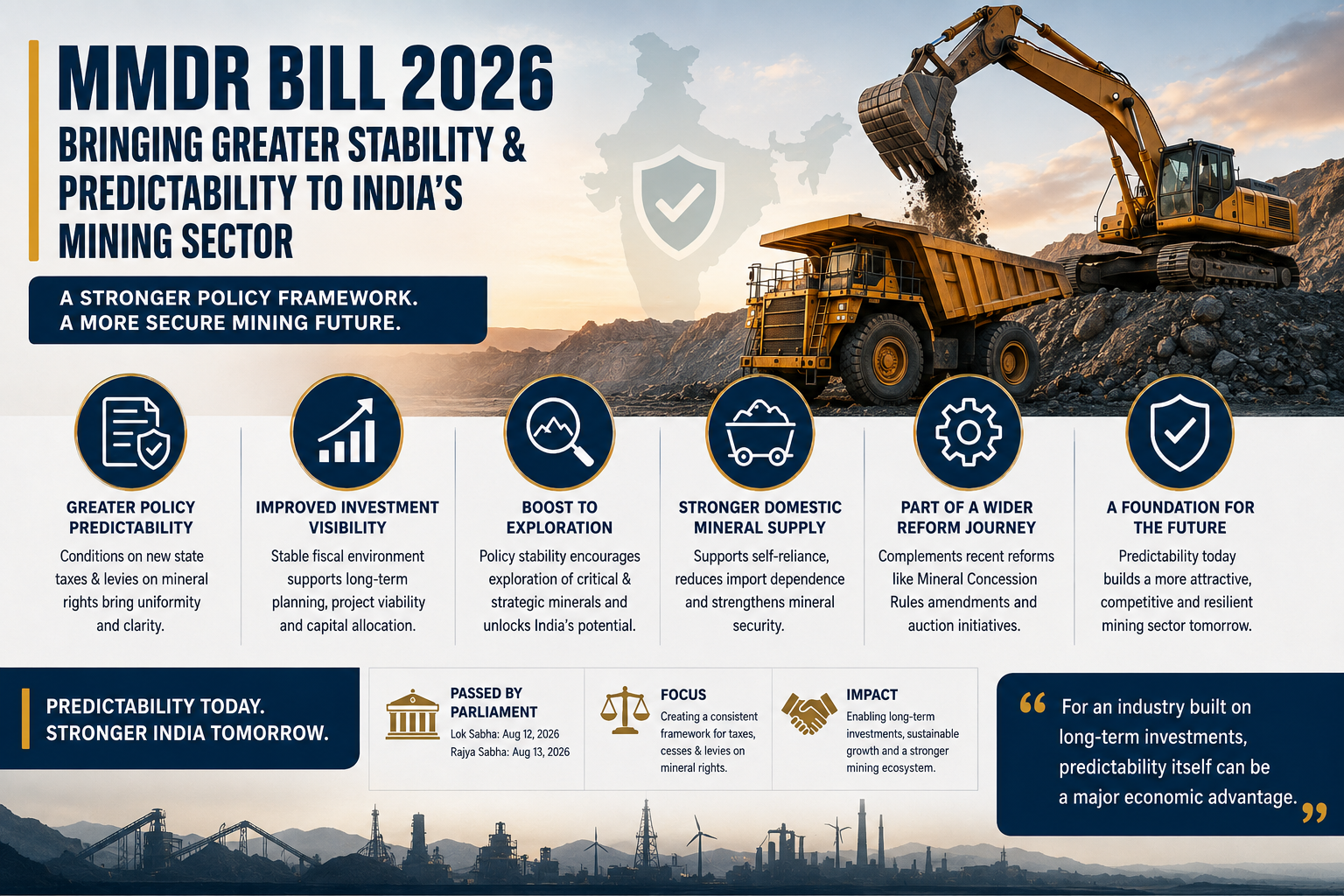
Hence the importance of MMDR Amendment Bill 2026 in the Indian mining Industry. The bill aims to increase uniformity in the power of states to impose new taxes, cesses and levies on mineral rights and mineral-bearing land, which passed both Houses of Parliament in August 2026.
Why predictability matters
Unlike most short cycle businesses, mining projects are unique. A company can invest several years mining a mineral deposit before it is set up for commercial production. After operations begin, the project needs to be continuously investing in machinery, infrastructure, technology and safety.
As other fiscal costs come in out of the blue, the economic feasibility of these investments can become more difficult.
The proposed structure from the MMDR Bill can offer more clarity in this regard by imposing conditions on the introduction of new taxes and levies at the State level based on the mineral rights. The aim is to establish a more consistent and reliable national system.
It can be especially important for companies that are established in many different states with mineral rich resources.
Improving investment visibility
Risk assessment is a critical component of investment decision making. When companies assess whether or not to pursue a new or extended mining project, they take into account such factors as regulatory uncertainty.
Stable and predictable tax regime can facilitate investment planning. Businesses can more accurately predict what costs might be involved, determine project feasibility and plan for future investments.
This does not necessarily mean that mining companies can expect lower taxes or greater profits. Instead, the benefits will be greater clarity on the policy landscape.
That’s significant when considering the Bill’s impact.
Stability can facilitate exploration.
There is huge mineral potential in India that remains untapped. If the country is to find new sources of minerals in the country, its exploration must be increased.
The government has already made changes to boost exploration and production of critical and strategic minerals. The Ministry of Mines has held auctions of critical mineral blocks, including the March 2026’s seventh tranche.
These can all be complemented by a stable policy framework that provides exploration and mining companies with greater certainty about investing in the sector.
Supporting domestic mineral supply
This also can help India in achieving the objective of reducing import dependence.
Lithium, graphite, rare earth elements, tungsten and vanadium are critical minerals that are becoming increasingly vital for new technologies and clean energy. They may suffer from geographically concentrated production as a result of their global supply chains.
India’s approach is thus to not only import minerals as required, but also augment its exploration, production and mineral processing capacity.
This is the underlying principle in the government’s recent reforms of the mining industry.
A wider reform journey
The MMDR Bill 2026 is not a standalone bill. It is part of several other reforms targeted at the improvement of the mining ecosystem in India.
The Ministry of Mines issued a review of the Mineral Concession Rules in March 2026 to enable contiguous areas and associated minerals to be included in mining leases. The rules also afforded more flexibility in the mineral sale from captive mines following the linked end-use requirements.
These should be implemented to boost mineral availability and promote efficient resource utilization.
What it means for the future
The most significant upside of the MMDR Bill for India’s mining sector might be the increased visibility of the policies.
A foreseeable Regulatory regime can facilitate businesses’ planning, utilization of new resources and long-term projects. It also has the potential to drive India’s mining sector as more investor-friendly in the metals and minerals sector.
There will be implementation barriers and questions of central and state authority will continue to be a part of the policy debate. Still, the law is a positive move towards a more robust mining ecosystem in India.
When projects are costly, require more time than usual, and are on a scale that demands significant investment, predictability itself may be a significant economic benefit.