
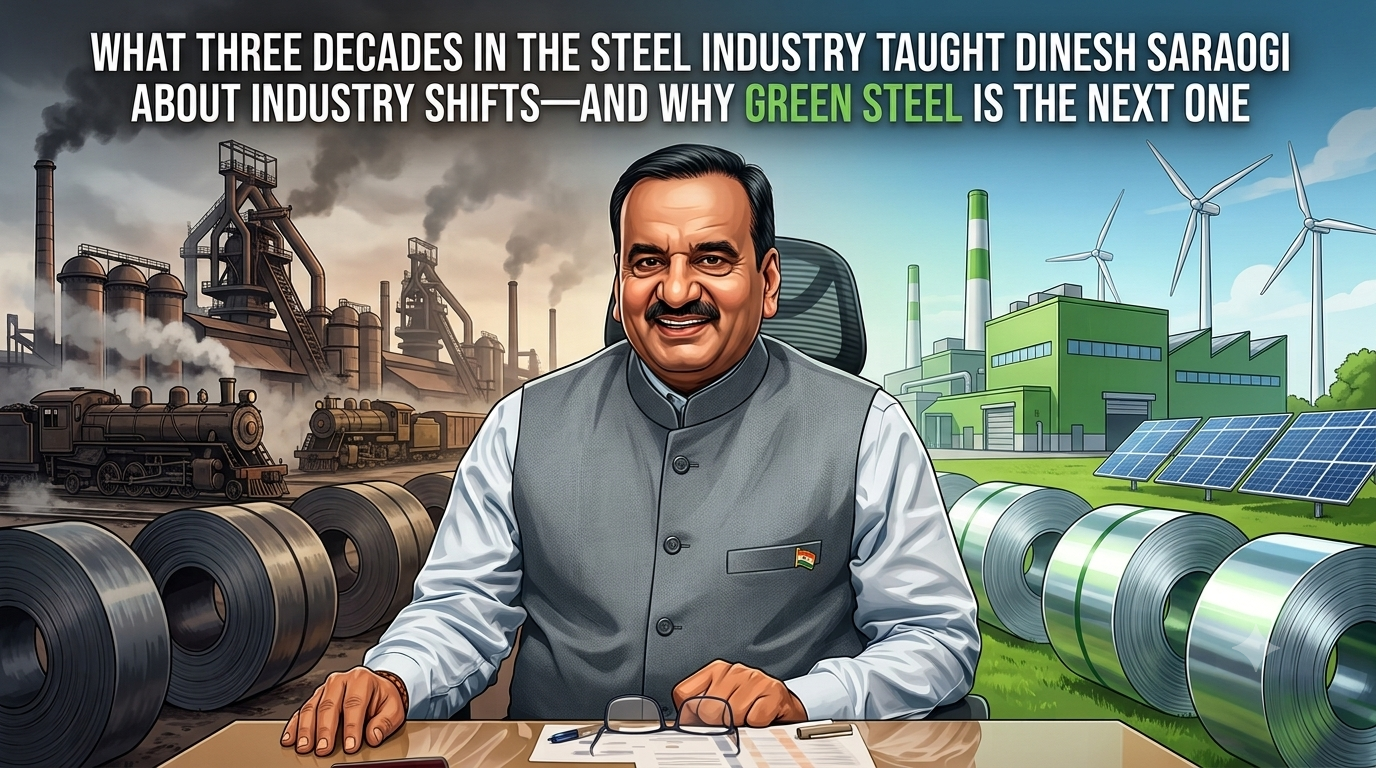
What Three Decades in the Steel Industry Taught Dinesh Saraogi About Industry Shifts—and Why Green Steel Is The Next One
When Dinesh Kumar Saraogi Jindal Steel began his career in the steel industry over three decades ago, the conversation in plant meetings was mainly about uptime, tonnage, and cost per unit. Sustainability was rarely discussed, if it appeared at all. Today, the same meeting rooms are filled with discussions on carbon intensity, green certification, and emissions reporting.
For Dinesh Saraogi, this isn’t a surprising transition. Instead, it is a pattern that he has seen before in his elaborate career spent at some of India’s most demanding steel companies, including his years at JSPL. His experience had already made him realize the importance of green steel, and he was already preparing for the major shift in the steel industry that India is about to experience in the upcoming years.
A career built on watching shifts before they became obvious:
Dinesh Kumar Saraogi Jindal Steel‘s years in the steel manufacturing industry were not spent on the sidelines. He had been in roles that had put him at the center of operational decision-making. This involves evaluating new technologies, greenlighting capital expenditure, and managing the plants through periods of intense change. During that span, he watched the industry undergo various transformations. This includes the shift towards automation and the tightening of quality standards. It also involved the growing sophistication of risk management in capital planning.
In each case, the companies that moved early captured an advantage that was difficult for the latecomers to close. The ones that treated the shift as someone else’s problem often found themselves scrambling to catch up once the shift became a market requirement rather than a market advantage. Dinesh Kumar Saraogi has spoken about this pattern in the context of his own risk-taking philosophy. This reflects a willingness to commit to a direction before the industry consensus fully forms.
The green steel shift: The need of the era
India’s steel sector is currently at the verge of experiencing a major shift. Steel companies from all across the world are trying to embrace green steel. This is mainly because of the growing awareness for sustainability throughout the world. This awareness has also brought about a shift in policies and regulations, making it further important for companies to opt for green steel transitions. Because of these transitions, companies are currently evaluating newer technologies and advanced processes which can further allow them to achieve their goals.
Why does Saraogi believe that the green steel shift is different and bigger?
What makes the current situation different is not just the fact that decarbonization is trending; it is also the pressure arriving from different directions. International buyers are now demanding lower embodied carbon. Regulatory frameworks like carbon border mechanisms are changing export economics. The domestic policies are also increasingly favoring producers who can demonstrate credible progress on emission reduction.
According to Dinesh Kumar Saraogi CEO, the shift has made it inevitable for companies in the steel industry to prepare for the transition. This isn’t just a passing phase; instead, it is a structural change in how the steel industry is going to be operated going forward. This is why Dinesh Saraogi has made a deliberate choice to position his advisory work around low-carbon steelmaking, green steel production, DRI, EAF, coal gasification, and energy efficiency. This is not a rebrand but a natural extension of his existing career path.
Reading the shift is only half the job:
Dinesh Kumar Saraogi Jindal Steel is quick to point out that identifying the shift earlier automatically doesn’t translate into acting on it well. Most plants have existing capital commitments, existing infrastructure, and existing operational rhythms that cannot be distracted at one go. The real work is deciding how to move towards a low-carbon future without disrupting current production and without overcommitting capital to unproven technology. The company should also not lose sight of the operational realities that come with running a plant on a day-to-day basis.
This is where Dinesh Saraogi’s three decades of hands-on experience matter a lot more than theoretical knowledge of adopting different decarbonization paths. Dinesh Saraogi has sat through multiple CAPEX committee meetings. He has also managed the plant-floor consequences of a technology decision that looked good on paper. He also understands that the decarbonization path has value only if it is built around what a plant can actually absorb and not around an industry-wide popular template.
In Conclusion:
For steel companies that are weighing how seriously to take the green steel conversation, Dinesh Kumar Saraogi’s advice is to follow a realistic path instead of blindly following what other companies are doing. A company should do only what is best for its current needs. He also believes that the cost of moving early is lower than the cost of catching up later. His approach also centers on practical plant-specific guidance rather than a generic industry commentary. So, companies looking forward to taking the green steel transition path can connect with Dinesh Saraogi for project evaluation, consultancy, and expert guidance.