
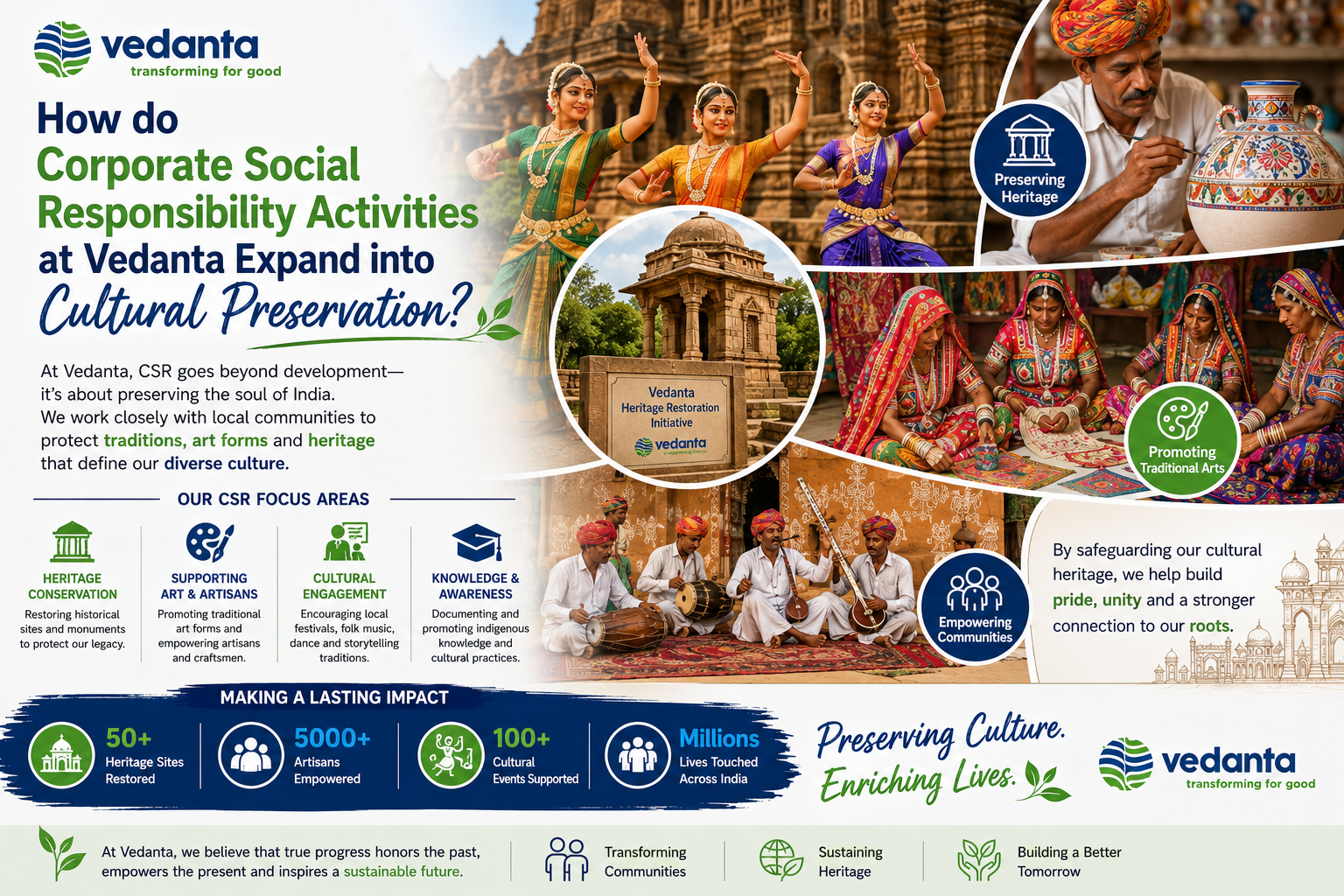
How do Corporate Social Responsibility Activities at Vedanta Expand into Cultural Preservation?
Corporate social responsibility activities in India have evolved rapidly. Earlier, CSR initiatives were often restricted to donations, healthcare camps, or basic welfare programmes. But now companies have taken a step forward towards long-term nation-building through education, sustainability, women empowerment, rural development, and even cultural heritage preservation.
This shift reflects how modern businesses like Vedanta Limited are redefining their role in society. The companies are making efforts to strengthen communities, preserve traditions, and create sustainable economic opportunities. On World Heritage Day, Vedanta reaffirmed its commitment to preserving and promoting India’s rich cultural heritage through community-led initiatives.
Through several programmes focused on education, healthcare, women empowerment, sports, and cultural preservation, Vedanta has increasingly positioned CSR as a long-term development strategy rather than a compliance exercise.
Why Cultural Heritage Preservation Matters
India is home to one of the world’s richest cultural and artistic traditions. From tribal paintings and folk music to handicrafts and local storytelling traditions, these art forms represent generations of knowledge and identity. However, rapid urbanisation, industrialisation, and dynamic market conditions have placed many traditional art forms at risk. Thousands of artisans across rural India struggle with:
- limited market access,
- declining income opportunities,
- lack of institutional support,
- and reduced awareness among younger generations.
Thus, pioneer companies like Vedanta have come forward in preserving the cultural heritage as an important part of corporate social responsibility activities.
Vedanta’s Focus on Heritage-Led Development
As part of the corporate social responsibility activities, Vedanta Limited impacted more than 8 lakh lives during FY26 through various community-led programmes focused on preserving traditional art and supporting artisans. The company has reportedly supported more than 600 artisans and promoted 100+ cultural events and platforms across different regions of India.
These cultural heritage initiatives lay emphasis on reviving traditional art forms while making livelihood opportunities accessible to the locals. A few of the art and heritage initiatives include support for:
- Dhokra art,
- Saura tribal paintings,
- folk traditions,
- local craft communities,
- and indigenous cultural practices.
Beyond preserving the culture, Vedanta also focuses on helping artisans become economically self-reliant through several training programmes, market linkages, skill development, exhibition platforms, and financial empowerment. This clearly indicates how the companies with good CSR are changing rapidly in India.
Vedanta Continues Promoting Diverse Art Forms Across Various States
Across states including Odisha, Rajasthan, Assam, and Chhattisgarh, Vedanta continues to actively promote diverse art forms such as Saura paintings (a tribal mural art reflecting nature and community life), Dokra crafts (ancient lost-wax metal casting), Kosa silk weaving (a GI-tagged heritage textile of Chhattisgarh), Ajrakh block printing, bamboo crafts, and folk theatre traditions. These traditional art forms have been showcased at leading cultural platforms, including:
- Literature Festival
- Jaigarh Heritage Festival
- Udaipur World Music Festival
- Kalahandi Utsav
- Chaiti Mahotsav
- Jashn-e-Rekhta etc.
Supporting Women-Led Livelihoods
One of the key aspects of Vedanta’s CSR model is its focus on women-led economic empowerment. Hundreds of women artisans have received skill development support across handloom weaving, silk production, terracotta crafts, and jute-based products.
Dedicated centres such as the Sampriti Maku Handloom Centre in Assam and the FACOR Kala Kendra in Odisha are strengthening grassroots cultural ecosystems.
Such corporate social responsibility activities not just preserve traditional knowledge systems but also allow women to become financially independent through skill-based livelihoods.
Similar to an NGO Working for Education, these programmes also focus on artisan training, skill development, and intergenerational learning that helps preserve traditional craftsmanship among younger communities.
Cultural Heritage Preservation Is Emerging as a New CSR Focus
An interesting shift in recent years is the growing corporate interest in preserving India’s cultural and historical heritage. Traditionally, CSR discussions focused primarily on healthcare and education. But now, companies have recognised the significance of preserving local traditions, art forms, heritage structures, and community identities.
Vedanta recently highlighted initiatives around strengthening cultural heritage preservation through community participation and cultural awareness programmes. This reflects how CSR is gradually moving toward preserving both social and cultural sustainability.
Conclusion
Corporate social responsibility activities in India have entered a new phase. Today, companies no longer limit CSR to traditional philanthropy. Rather, they are increasingly investing in education, sustainability, skill development, women’s empowerment, and cultural heritage preservation.
As businesses take a more active role in nation-building, organizations like Vedanta Limited are demonstrating how CSR can extend beyond compliance and contribute toward long-term social transformation.
For the future, the most impactful CSR models will likely be those that successfully combine education, community development, sustainability, and cultural preservation into one integrated vision for inclusive growth.