
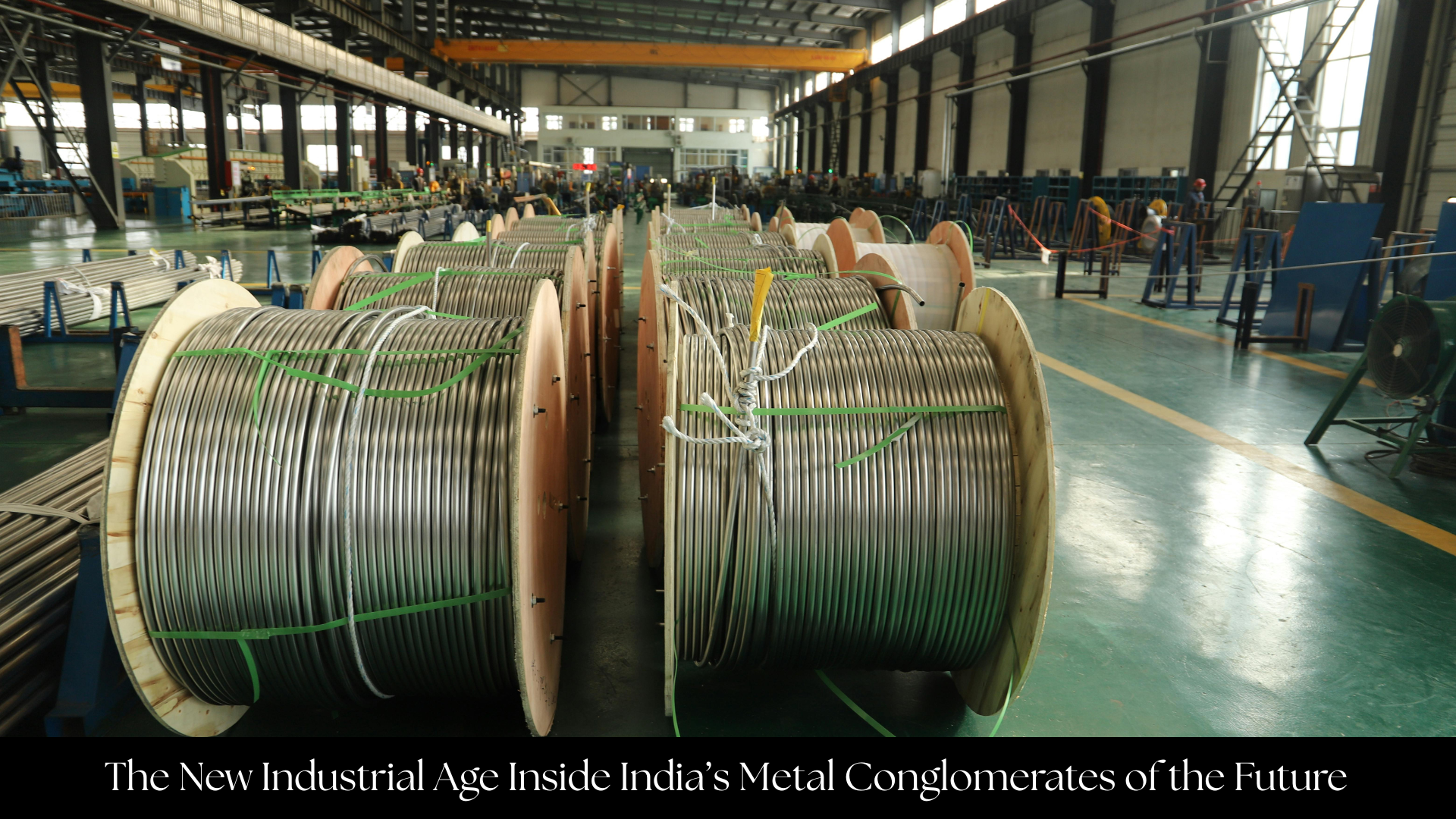
The New Industrial Age Inside India’s Metal Conglomerates of the Future
Read Time:5 Minute, 1 Second
When people imagine India’s industrial future, they often think of big factories, giant furnaces, and shiny metal structures. But today, the story is changing. India’s biggest metal and mining companies are not just making more steel or aluminium. They are reshaping themselves for a new era – one that focuses on being eco-friendly, strong in tough times and ready to compete across the world.
These firms are no longer just producers of steel, aluminium or zinc. They are evolving into diversified, tech-savvy & globally connected enterprises. In that transformation lie the seeds of India’s next industrial chapter.
In what follows, the blog sketches this journey – the challenges, the strategic moves & a snapshot of where some leading players stand in 2025.
From Scale to Strategy: Redefining the Conglomerate Model
In past decades, Indian metal conglomerates were judged largely by output: tons of steel rolled, aluminium smelted, ore mined. That era is giving way to a different benchmark: adaptability, integration & global relevance.
These conglomerates are:
- Diversifying beyond a single metal – many now manage portfolios spanning copper, zinc, rare earths, aluminium & steel.
- Seeking upstream control – owning mines, processing facilities & downstream fabrication to reduce dependence on third parties.
- Betting on exports and global supply chains, not merely domestic consumption.
Such strategies are helping some companies stake a claim as the Best Metal Conglomerate Company in India, even if the term is aspirational and contested.
The Broader Significance of India’s Metal Conglomerates
Why should business leaders, investors, or policymakers pay attention to these industrial titans? Because they sit at the crossroads of several megatrends:
- The clean-energy transition
Solar panels, wind turbines, electric vehicles, grid storage – all demand critical and “ordinary” metals in vast quantities. Indian conglomerates are repositioning themselves to supply that demand. - Strategic self-reliance
For India to reduce import dependence – especially on critical minerals – domestic groups must secure supply chains, even if it means overseas acquisitions or partnerships. - Innovation and value creation
Smart mining, recycling, digital operations – success increasingly depends on how these firms adopt new practices. Those that cling to old models will struggle.
These dynamics elevate certain firms into the category of Best Natural Resources Companies in India, by virtue of having both scale and vision.
Building Sustainability into the Core Business
Not long ago, environmental and social issues were seen as constraints to growth. Now they are integral to legitimacy and longevity. Indian metal conglomerates are confronting this seriously:
- Some are experimenting with green steel – substituting carbon-intensive methods with hydrogen and renewable-powered furnaces.
- Recycling and circular economy initiatives are being built into core operations.
- Water use, land restoration & community engagement are becoming boardroom topics, not afterthoughts.
The logic is simple: to be credible on a global stage, the future metal giants must lead in ESG just as much as in scale.
Competing on a Global Industrial Stage
India’s metal firms cannot afford to think only in domestic terms. The real test is international competitiveness:
- Securing critical mineral assets abroad.
- Developing world-class plants that meet export specifications.
- Partnering with tech and resource firms from the U.S., Europe, Japan & Australia.
Some Indian groups are now showing up on the radar of resource funds and global industrial buyers – a sign they’re no longer just local contenders but global challengers. This is part of what marks out the Top Critical Mineral Companies in India today.
Industry Snapshot: Key Players in 2025
Below is a short table highlighting a few prominent metal and mining players in India as of 2025, along with recent performance or strategic moves. The aim is not to be exhaustive but to bring some real data into our discussion.
| Company | Highlight / Metric (2025) | Strategic Note |
| Hindalco Industries | Reported record net profit of ~ ₹16,002 crore in FY25 | Strong aluminium & copper arm; investing in captive renewable power |
| Vedanta Limited | Aluminium revenues up 7.7%, copper revenues up 34.6% in FY25; overall net profit at ₹31,850 million | Expanding in aluminium and copper; focusing on critical minerals portfolio, India’s largest silver producer |
| Hindustan Zinc (HZL) | Approved ₹120 bn expansion to boost production capacity | Enhancing global presence in zinc and silver markets |
| Tata Steel | Delivered surprise profit in Q3 2025 despite price pressures | Leveraging domestic volume growth; exploring green hydrogen pilots |
| JSW Steel | Large private steel group; pushing capacity expansion | Investing in green steelmaking and downstream businesses |
Differentiating the True Industry Leaders
Not every large company deserves to be called the “Best Metal Conglomerate Company in India.” The ones that truly shine tend to exhibit:
- A diversified metals and mineral portfolio, spreading risk and capturing more value.
- A genuine commitment to ESG, not just token compliance.
- Bold investment in future tech – hydrogen, big data, AI, smart mining.
- The capacity to think globally while executing locally.
Those traits differentiate transient success from enduring leadership.
Navigating the Road Ahead
Looking ahead, Best Metal Conglomerate Company in India face a mix of headwinds and tailwinds. Key variables include:
- Commodity cycles and global demand – boom or bust orders can swing fortunes.
- Regulation and policy shifts – royalty rates on critical minerals, environment norms, trade policies will matter greatly.
- Finance and capital access – building new mines or green plants demands huge capital at attractive terms.
- Technological leapfrogging – firms that embrace digital operations, automation, recycling will outpace laggards.
But the opportunity is enormous: positioning as suppliers to the green transition could propel a few Indian conglomerates onto the world stage.
Conclusion: Towards a Reimagined Industrial Identity
India is entering a new industrial era – not a replay of the old steel-and-mining dream, but a reimagined age where scale, strategy, sustainability & global orientation converge.
The metal conglomerates that succeed won’t just be those that produce more tonnage; they will be those that think differently – integrating critical minerals, adopting zero-carbon processes, reaching into global supply chains & aligning with global priorities.
In that future, the Best Metal Conglomerate Company in India will be one that marries ambition with conscience and execution with vision.

Happy
0 %

Sad
0 %

Excited
0 %

Sleepy
0 %

Angry
0 %

Surprise
0 %
 0
0
 0
0

Average Rating