
Safeguard Against Ransomware: Build a Strong Defense
Read Time:4 Minute, 41 Second
Cyberattacks are no longer isolated incidents—they’re a persistent, evolving threat to every organization. The rise of ransomware has redefined how businesses approach cybersecurity, pushing data protection to the forefront of operational priorities. Prevention, preparation, and resilience are essential to any successful defense plan. Ransomware is no longer a rare occurrence reserved for large enterprises. Businesses of all sizes face rising threats as attackers refine their tactics, seeking vulnerabilities at every opportunity. Modern organizations must act decisively to protect your data, ensuring sensitive information stays secure and operations remain uninterrupted, even in the face of a determined attack. A robust defense relies on multilayered strategies that combine advanced technology, staff awareness, and well-practiced response plans.
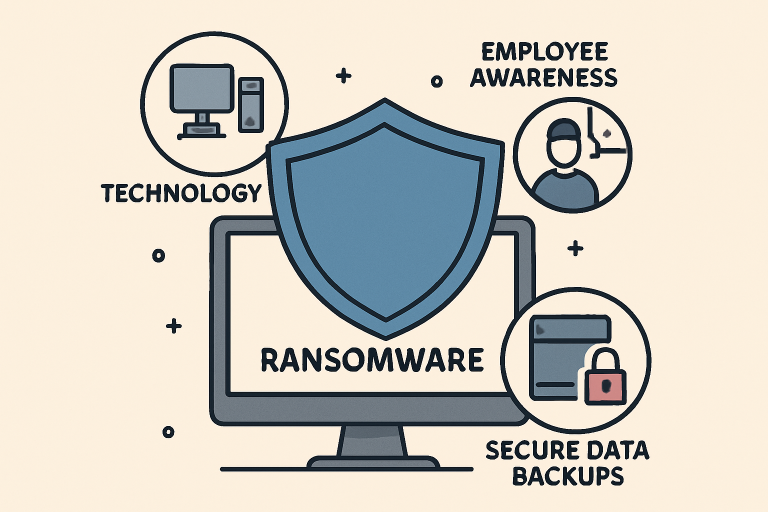
The foundation for safeguarding digital assets involves more than just firewalls and antivirus solutions. A resilient defense focuses on proactive risk identification, access restriction, and robust data backup methods. Adequate ransomware protection also means fostering a cybersecurity-conscious culture, where every employee actively participates in organizational defense efforts.
Implement Advanced Cybersecurity Measures
Building a resilient ransomware defense starts with advanced security measures. Frequent vulnerability assessments are essential, spotlighting weaknesses that threat actors frequently exploit. Organizations should also integrate Endpoint Detection and Response (EDR) tools, providing real-time visibility into endpoint activity and automating responses to malicious behavior. Network segmentation, which divides networks into smaller, manageable areas, helps contain any potential outbreak and limits the damage ransomware can inflict.
Another critical consideration is privileged account management. Limiting admin rights and monitoring privilege escalation attempts adds another barrier against unauthorized actions. Pairing these controls with real-time alerting systems ensures rapid awareness and the ability to take decisive action when anomalies arise.
Adopt a Zero Trust Architecture
Zero Trust Architecture fundamentally changes access management by enforcing the notion that no user or device should ever be automatically trusted. This security model mandates continuous authentication and verification, regardless of network location. Implementing Multi-Factor Authentication (MFA) for all users is standard best practice under Zero Trust, as is enforcing the principle of least privilege—only granting the minimum access necessary for each role.
Microsegmentation, in conjunction with Zero Trust, isolates sensitive workloads and restricts lateral movement within networks. Organizations can contain breaches before attackers gain a critical foothold with detailed user activity monitoring and strict authentication.
Enhance Employee Cybersecurity Awareness
Even the most sophisticated defenses can be undone by a single human error. Ransomware campaigns often begin with phishing emails or malicious links, preying on unsuspecting employees. Ongoing cybersecurity education programs are crucial—these should cover how to recognize suspicious messages, what to do when encountering unexpected links or attachments, and how to report threats. Simulated phishing attacks offer employees practical experience and reinforce vigilance against evolving tactics.
Adoption of cybersecurity awareness also relies on a culture of communication. Employees should feel empowered to report incidents without fear of retribution, ensuring quick escalation and containment when needed.
Maintain Immutable, Air-Gapped Backups
Data backup strategies are the last line of defense against ransomware. To ensure complete recoverability, organizations must create immutable backups that cannot be altered or deleted, regardless of attacker actions. These backups should reside in air-gapped environments, meaning they are physically or logically isolated from the main network. This separation makes it virtually impossible for ransomware to reach and encrypt backup copies.
Regular backup testing is just as important as the backup itself. Restore drills—where data is retrieved from backups and reinstated—are essential to confirm recovery procedures work correctly, allowing business continuity even if primary systems are compromised.
Develop a Comprehensive Incident Response Plan
An effective incident response plan ensures a coordinated, rapid, and thorough handling of ransomware events. The plan should clearly outline the steps for identifying and containing the threat, communicating with staff and stakeholders, and restoring from backups. Establishing roles and responsibilities means that, in an emergency, the right people act quickly and efficiently.
Regular tabletop exercises—where teams walk through realistic attack scenarios—help refine incident response strategies and strengthen cross-functional communication. Post-incident reviews provide lessons learned, leading to meaningful improvements in future readiness.
Leverage Advanced Threat Detection Tools
To outpace ransomware operators, organizations benefit from advanced detection tools like Managed Detection and Response (MDR), Security Information and Event Management (SIEM) platforms, and AI-powered threat analytics. These solutions deliver around-the-clock monitoring and leverage extensive threat intelligence databases to spot indicators of compromise early. Automated responses and threat hunting capabilities further empower teams to disrupt attacks before data loss or damage occurs.
Regularly Update Systems and Software
Unpatched vulnerabilities are a leading cause of ransomware incidents. Establishing automated patch management ensures prompt updates across operating systems, applications, and device firmware. Routine update cycles and careful monitoring for end-of-life software protect against known exploits, shrinking the organization’s attack surface substantially.
Implement Network Segmentation and Microsegmentation
Network segmentation divides the organization’s internal networks into distinct zones, each protected by its own access controls and monitoring. If ransomware breaches one area, it is contained and less likely to spread to other critical systems or sensitive data stores. Microsegmentation, a more granular approach, isolates workloads or applications, making lateral movement for attackers exceedingly difficult.
Conclusion
Effectively countering ransomware takes a unified approach, blending advanced technology, smart architecture, human vigilance, and clear processes. By investing in robust controls—from air-gapped, immutable backups and Zero Trust adoption to nurturing a cyber-aware workforce—organizations can dramatically improve their ability to detect, contain, and rapidly recover from ransomware attacks. Resilience is about being ready for the unexpected and taking every step possible to ensure that, whatever threat emerges, business operations and data remain secure.

Happy
0 %

Sad
0 %

Excited
0 %

Sleepy
0 %

Angry
0 %

Surprise
0 %
 0
0
 0
0


Average Rating