
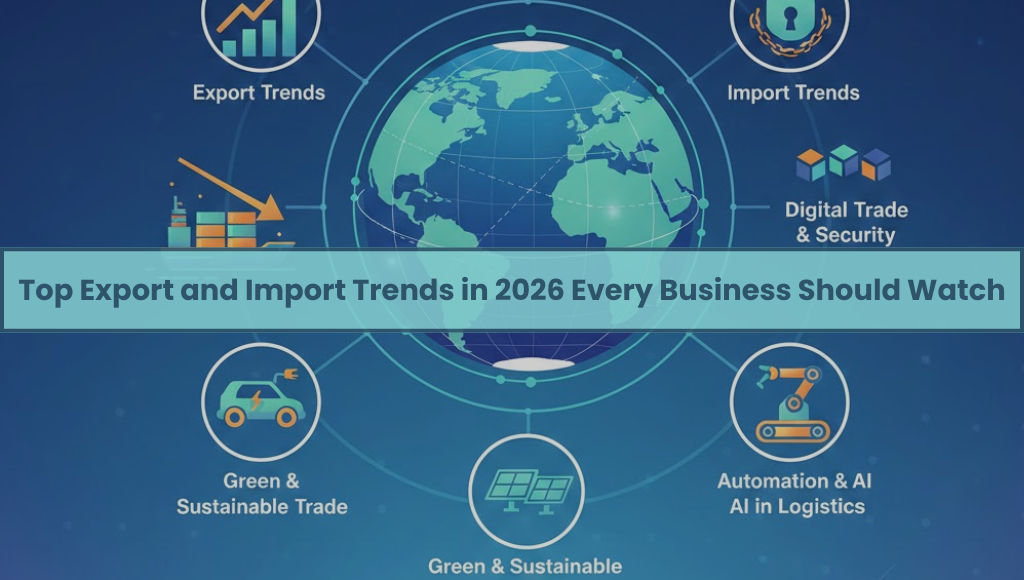
Top Export and Import Trends in 2026 Every Business Should Watch
2026 is going to shape everything. For international trade, it is going to be the most crucial and transformative year. Rebalancing of supply chain, shifting of geo-political alliances, rising standards of sustainability, regionalization, digital documentation, and more are going to rewrite the export-import trends, not just in India, but globally. If we talk about the Indian market specifically, exporters from the sectors, like engineering goods, agro-commodities, seafood, chemicals and minerals, pharmaceuticals, and others, will witness unprecedented opportunities and challenges.
To find out more about the trends, continue reading this post.
What exporters should know?
As the recent trade looks, the demand is anticipated to be higher in certain regions. These include Southwest Asia, Latin America, Eastern Europe, West Asia, and Africa. With a solid interest of buyers in high-quality, competitively priced, and sustainable goods, Indian traders have an opportunity to make the most out of it. However, to succeed, they should understand the following:
- Where is international demand moving or shifting?
- Which category of products is in demand globally?
- What are the new rules and expectations, and why do they matter?
- How to adapt new supply chain, documentation, and shipping strategies?
- How can different platforms help with global growth?
What are the major global demands/trends in 2026?
It is believed that 2026 is going to shape the following segments heavily:
- Green procurement and sustainability: Global buyers, especially from Japan, European Nations, and GCC countries, are giving priority to green and sustainable items. This means they are more interested in eco-friendly packing, low-carbon-emission supply chains, digital and traceable documentation, and clean energy-based production.
- CBAM: It stands for the Carbon Border Adjustment Mechanism. These are the policies that are affecting buyers’ purchasing decisions in Canada, the United Kingdom, and other European countries.
- Regionalization: After the COVID-19 impact, companies are now reducing their dependency on a single country for sourcing materials. This has increased the opportunities for all India-based exporters within West Asia, Gulf nations, ASEAN, Latin America, Africa, and Eastern Europe to emerge as a leading supplier for steel, textiles, chemicals, engineering goods, agro foods, and others.
- Digital trade: It has become non-negotiable for businesses these days. Right from digital certificates to e-invoices, digital trade is a need. This is why you will see more paperless documentation, digital compliance, real-time visibility of the shipment, and blockchain-based services. By using this, Indian exporters will gain a competitive advantage over others.
- Spending patterns are changing: Not just in India, but this is changing globally. The demand is shifting due to a rise in the population of the middle class, a shift towards organic, healthy, and premium foods, increased infrastructure and construction work, and more. Every business should understand this export-import trend to modify its plans.
Global markets that will see a boost in 2026
Here are the major global markets that will dominate the demand in 2026:
- Southeast Asia: These include popular countries, such as Malaysia, Thailand, Indonesia, Vietnam, and the Philippines. They will be importing more goods manufactured in India because of manufacturing expansion, strategic partnership, and dependency on India-based raw and agro materials.
In 2026, top products that will be high in demand are marine products, rice, engineering and steel goods, chemicals, plastics, pharmaceuticals, and electrical machines. Since ASEAN importers need cost-effective suppliers and diversification, Indian importers have a chance to make the most out of it.
- Africa: This region includes countries like Kenya, South Africa, Ghana, Nigeria, and Egypt. In 2026, they will continue trading with India for items such as processed food, wheat, rice, engineering goods, FMCG products, pharmaceuticals, and others. From this viewpoint, 2026 is going to be a year of infrastructure growth and rapid urbanization for Indian suppliers and businesses.
- GCC or Middle East: These include nations, such as Omar, Qatar, UAE, Saudi Arabia, and others. For these nations, the demand for food grains, seafood, frozen foods, electronics, engineering items, textiles, etc., will be high.
- CIS markets and Eastern Europe: In this list, countries such as Georgia, Uzbekistan, Romania, and Poland are included. The demand for importing goods within the categories of agro foods, machinery, metals, and energy will continue to rise. Along with this, these nations’ demand for processed foods, agro foods, pharmaceuticals, spare parts, steel, pipes, etc., will spike in 2026. This year, India is going to be a super alternative for these.
- Latin America: To tap into the growing market of Latin American countries, like Colombia, Mexico, Peru, and Brazil, India will have a solid opportunity this year. These nations will ask for more seafood, spices, rice, specialty chemicals, auto parts, textiles, pharmaceuticals, and other items.
Closure
The export-import trends will change the face of global markets. If we talk about India, it has an opportunity to take over markets by fulfilling the growing demands of food and agro commodities, marine and seafood, healthcare and pharmaceutical items, engineering goods, and more. To understand more about these trends and avail of the logistics services, connect with BSA Logistics for professional assistance.