
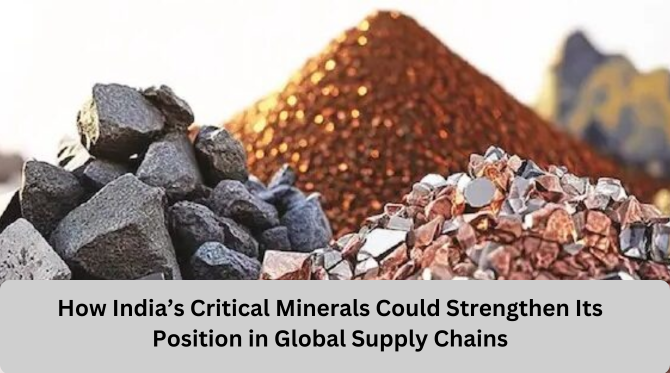
How India’s Critical Minerals Could Strengthen Its Position in Global Supply Chains
The global demand for critical minerals—lithium, graphite, nickel, cobalt, rare earths, and copper—is surging. For India, turning mined ore into refined products and components is a strategic opportunity: it reduces import vulnerability, creates higher-value manufacturing jobs, and positions Indian firms to compete as suppliers to global industries. This blog explains how India can realize that potential and profiles the top critical mineral companies in India that are already moving the needle—including Vedanta and four other leading players with real 2025 data and sources.
Why critical minerals are a strategic priority
Critical minerals are foundational to batteries, electric vehicles (EVs) wind turbines, defence systems and advanced electronics. Governments and corporates are racing to secure reliable supplies & build domestic processing because raw ore alone captures only a tiny share of the value chain. India has responded with policy moves that prioritise exploration processing, recycling and downstream manufacturing -an agenda that can convert resource endowments into industrial strength.
The corporate backbone: who to watch
Below are five companies that exemplify India’s emerging critical-minerals ecosystem. These firms are among the Top Critical Mineral Companies in India -companies that can scale reserves into processing capacity, and help India climb the value ladder.
Vedanta Limited -the flagship integrator
Vedanta has publicly signalled ambitions to expand into rare earths and other battery-related metals, moving beyond its traditional metal’s portfolio. As of October 2025 Vedanta’s market capitalisation was reported at roughly USD 22 billion, reflecting its substantial scale and capacity to invest in midstream facilities and processing. Vedanta’s integrated capabilities make it one of the Indian firms best positioned to progress into the ranks of Leading Global Critical Mineral Companies. It is also among the top private players with the most number of critical mineral blocks acquired.
Adani Enterprises -rapid build-out of refining and smelting
Adani Enterprises has been executing large metallurgical projects; in 2025 the company was reported to be about to commission a major copper smelter -a strategic midstream asset for the supply of refined copper and other base metals critical to electrification and grid infrastructure. Adani’s investments in refining and its ambition to host one of the world’s largest metallurgical complexes underline why it’s on the short list of Top Critical Mineral Companies in India.
Graphite India -an anode supply play
Graphite India is stepping into synthetic graphite anode material (SGAM) manufacturing, a key component for lithium-ion batteries. In 2025 the company signed memoranda & sought approvals for large-scale SGAM projects, including an announced investment for manufacturing facilities in Maharashtra. These moves directly target the battery supply chain and make Graphite India a practical example of how Indian firms can capture midstream value.
Indian Rare Earths Limited (IREL) -national rare-earth capacity
IREL the public sector rare-earth producer has stepped into the spotlight as India looks to reduce import dependence for neodymium & other magnet metals. In 2025 IREL planned to scale domestic neodymium production considerably (targets in the hundreds of tonnes range by the mid-2020s) & has been at the centre of policy discussions about prioritising domestic supply for strategic industries. IREL’s role is crucial to any national strategy to become one of the Leading Global Critical Mineral Companies at scale.
Hindalco / Aditya Birla Group -aluminium and beyond
Hindalco (part of the Aditya Birla group) and related industrial houses are also investing in metals and downstream processing that feed into electrification and lightweighting. Aluminium remains important for vehicles and grid equipment; Hindalco’s market presence and downstream reach make it one of the Best Natural Resources Companies in India to watch as value chains shift toward decarbonised manufacturing.
How these companies together build a national advantage
When the Best Natural Resources Companies in India -public and private -coordinate exploration, processing and manufacturing, India gains three concrete advantages:
- Value capture: Refining and precursor production onshore means exports of higher-margin intermediate goods rather than raw ore. That raises export revenues and domestic job creation.
- Resilience: Domestic processing and strategic overseas partnerships reduce dependence on single suppliers and geopolitical risks. India is actively negotiating supply partnerships and overseas equity stakes to stabilise access.
- Industrial ecosystem: Battery plants, anode/cathode material manufacturers, magnet producers, and recyclers clustered together lower cost and accelerate innovation.
These combined moves can turn a patchwork of suppliers into a coordinated set of firms capable of being Leading Global Critical Mineral Companies -if policy, capital and skills are aligned.
Policy and industry actions that will determine success
To convert corporate intent into global competitiveness, India needs focused action:
- Predictable licensing and auctions to crowd in private capital.
- Incentives for midstream plants (precursors, refining, anode/cathode manufacturing) to reduce take-off costs.
- Research hubs and public-private labs linking IITs, GSI and industry to deploy beneficiation and refining technologies.
- Circularity incentives to scale battery and e-waste recycling, creating secondary feedstock for domestic processors.
Risks to manage
Price volatility in global commodity markets can erode margins and delay project viability while community consent and environmental clearances remain sensitive issues that can stall mining or refining operations. The technical complexity of refining critical minerals like lithium or rare earths further adds to cost and time.
To mitigate these, India must diversify supply through both domestic exploration and overseas partnerships, adopt pilot-scale processing before full-scale rollout and enforce robust environmental, social and governance (ESG) standards.
Transparent stakeholder engagement, responsible resource use and sustainable mining practices will be key to attracting stable, long-term investment in this sector.
Conclusion -from resource owner to supply-chain leader
India’s moment is now. With firms like Vedanta, Adani Enterprises, Graphite India, IREL, and Hindalco making concrete 2025-era moves, the foundations of a competitive midstream exist. If the government and industry execute coherent policy, scale processing, and deepen recycling, India can produce more than ore: it can build exportable battery materials, magnets and alloys that place Indian businesses among the Leading Global Critical Mineral Companies. That outcome -resilient supply chains, higher-value exports and domestic job creation -will be a defining industrial achievement of the decade.